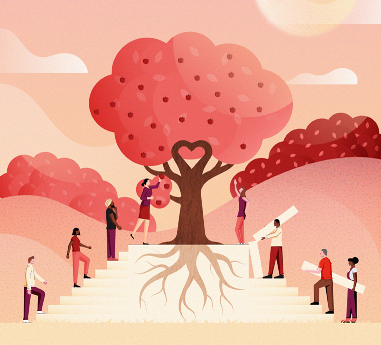
THIS IS WHAT MOVEMENT LOOKS LIKESometimes change feels impossibly slow. And then you look up
and realize — something is moving. In Geneva, advocates from every corner of the world have just filed their submissions into the UN process that could deliver the first-ever legally binding instrument on the human rights of older people. A mountain is being chipped away. Slowly, deliberately, unstoppably. In Zimbabwe, one PIONeer with a video camera and unshakeable conviction walked into the President's office and stayed for an hour. Then she went to
parliament. The mountain is moving. In Hamburg, older people are going to concerts with younger companions. In France, a website born out of COVID isolation is buzzing with life. In Central America, clean cookstoves are changing lives one family at a time. In Zimbabwe, older women are dressing up for high tea and claiming the dignity that was always theirs. In every corner of the world, PIONeers are passing it on. This edition is packed
with the evidence, the inspiration, and the tools you need to keep going: - The UN process — where it stands and what it means
- Stanford's robots — reimagining independence and care
- The AGE Barometer — ammunition for every advocate
- Ashton Applewhite — walking the walk, literally
- Helen Hirsh Spence — proof that the best chapters come later
- Global Snippets — change, one
corner at a time
- Open House — come and find your community
Welcome to your PIONeer Gazette.
Welcome to the movement. |
The countdown is on. With the 22 April deadline now behind us, advocates for older people's rights from every corner of the globe have filed
their submissions into Geneva — setting the stage for the UN's Intergovernmental Working Group on Ageing (IGWA) working session, 13–16 July. Three big questions are on the table:
- What overarching framework should guide the international legally binding instrument on the human rights of older persons?
- What core principles should underpin it — to make sure it actually delivers?
- What structure will give it the clarity and teeth it needs?
Advocacy is like chipping away at a mountain range — the change is imperceptible, until suddenly, it isn't. Here's why
every chip matters. Fourteen years. 14 meetings. 900 documents. Then, the open-ended working group on ageing (2010–2024) ended, and now the baton has passed to the UN Human Rights Council, with a clear mandate to draft a legally binding instrument (LBI) on the human rights of older people. This is a landmark moment. Timelines suggest 3 to 5 years to the finish line — but the direction is set. And while the global machinery turns, our own PIONeers are already
making things happen on the ground. From Geneva to Zimbabwe In 2023, Beatrice Sithole, our Zimbabwe PIONeer, submitted a video to GAROP's Rights Rally with a simple, powerful demand: give older Zimbabweans their own ministry. That video opened a door nobody expected. Beatrice won a one-hour audience with the President of Zimbabwe — and she used every minute of it. She has since joined forces with a
federation of civil society organizations led by and for older people, and together they petitioned the government and were received in parliament in March 2026. The response? Encouraging. The demands were well received — agreement, it seems, was never the obstacle. Budget was. We're watching this space.
Moira Allan
Co-Founder & International Coordinator
Pass It On Network
|
GLOBAL 50/50 ONLINE CONVERSATION |
The Common Thread:
A
Multigenerational Pondering
What questions about life are truly universal—and what do they reveal about our intergenerational world?
Join us on May 11th for a collective pondering. We extend a deliberate invitation to those in the "ages in between"—the 40s and 50s. You carry a unique perspective that is often missing
from these conversations. We need your thread in this weave. You probably know at least one or two such people. Invite them along. The Pass It On Network is strongest when it's most diverse. |
Curious about the Pass It On Network? Our invitation is open. Every month, our co-founder and international coordinator Moira Allan throws open the doors for anyone who wants to find out what PIONeers are all about — whether you're a seasoned advocate or just starting to explore. We run two sessions every month to
make sure no PIONeer — wherever you are in the world — gets left out. Come with questions. Leave with community Not sure if it's for you? Come anyway. That's what Open House is for. Pass it on. Pass it forward. Pass it everywhere. |
Americas, Europe, Africa
1pm EDT / 5pm BST
7pm CEST / 7pm SAST | Asia, Australasia
7am CEST / 6am BST
1pm SGT / 3pm AEST |
ADVOCATING FOR THE RIGHTS OF
OLDER PEOPLE |
THE INEQUALITY THAT AGES WITH YOU
Here's a number that should stop you in your tracks:
By 2050, four out of every five older adults on the planet will live in low- and middle-income countries (LMICs). And between now and then, LMICs will account for a staggering 85% of all global population growth among people aged 65 and over. This is the
new face of ageing. And it comes with a crisis hiding in plain sight — ageing inequity. Not the inequalities that suddenly appear in old age. The ones that accumulate across an entire lifetime — compounding quietly, year after year, until they hit hardest precisely when people are most vulnerable. A landmark report — initiated by AARP International with Economist Impact (2022) — takes this head on. It covers the full landscape: - Gender disparity —ageing is not equal between men and women
- The rural-urban divide — because where you live shapes how you age
- Informal economies — where millions work without safety nets
- Traditional care networks — carrying enormous weight, largely
invisible
This is exactly why PIONeers exist. Our network was built on the conviction that change doesn't travel from the top down — it travels person to person, community to community. While global reports map the scale of the problem, PIONeers are on the ground living it, naming it, and fighting it — from Zimbabwe to Geneva and everywhere in between. Read the report. Then ask yourself: what can I pass
on? THE WORLD IS RESHAPING ITSELF — ARE WE NOTICING?
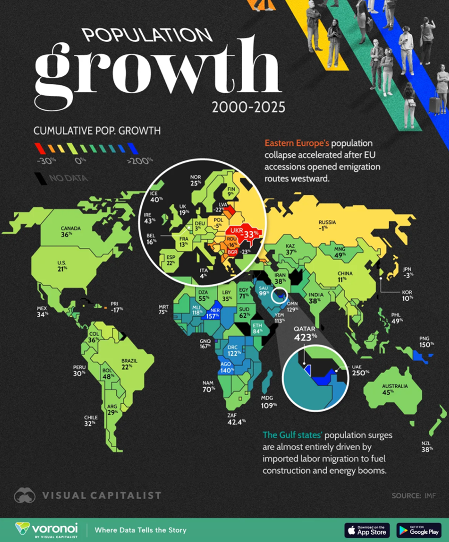
A stunning new interactive map from Visual Capitalist, drawing on IMF data, charts 25 years of global population shifts — and the picture it paints is impossible to ignore.
+400%. That's how
much Qatar's population has grown since 2000. Let that sink in. At the other end of the spectrum the number of people in 1 in 7 countries is shrinking — populations declining quietly while the world looks elsewhere. For advocates of older people's rights, the message is clear: the demographic changes are not coming — they're already here. The wave of global ageing we talk about in boardrooms and UN sessions is visible, measurable, and
accelerating. When 1 in 7 countries is shrinking, the question isn't whether ageing populations will reshape our world. It's whether our policies, our rights frameworks, and our communities are ready. That's why PIONeers exist. AGE BAROMETER 2025:
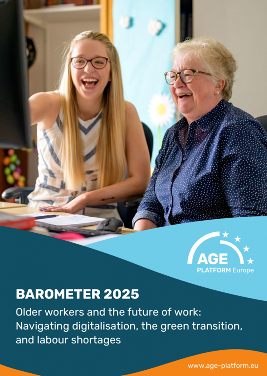
IS THE WORLD OF WORK WORKING FOR OLDER PEOPLE?Every year, AGE Platform Europe takes a hard, unflinching look at the social realities and human rights of older people across Europe. And every year, it matters. The 2025 AGE Barometer asks a question that can't wait: As digitalization accelerates, the green transition reshapes entire industries, and labor
shortages bite — who is making sure older workers aren't left behind? The 2025 edition digs deep into how these seismic shifts are affecting older workers today — and what they mean for the opportunities and challenges ahead. But this isn't just a report full of problems, The Barometer 2025 is a robust advocacy tool with: - Inspiring practices from AGE members from 18 European Member States
- Concrete recommendations*for age-friendly employment policies
- Recognition of the real, measurable value older workers bring
- Strategies to ensure no one gets left behind in the transitions ahead
This isn’t wishful thinking. These are actionable demands — and every PIONeer can carry them: - Rethink employment strategies — older workers are not an afterthought. Build them in from the start.
- Invest in lifelong learning — digital and green skills don't belong only to the young.
- Champion intergenerational workplaces — experience and innovation are stronger together than apart.
- Adapt working environments — longer careers are an asset, but only if the conditions make them possible.
Remember the three questions at the heart of the UN's proposed legally binding instrument on older people's rights?
The AGE Barometer is exactly the kind of evidence-based, ground-level advocacy that answers them — and makes the case for why that instrument cannot come soon enough. THE ROBOTS ARE COMING — DON'T PANIC!
Imagine a robot smaller than a grain of sand, dissolving a deadly blood clot before it can do its damage. Now imagine another — life-sized, friendly — tidying your home, keeping you company, and keeping watch so you can live independently, on your own terms.
Stanford engineers are not imagining this. They're building it. Read the
full article here. From microscopic medical marvels to full-size companion droids, the innovators at Stanford are fundamentally reimagining what it means to grow older — with technology designed not to replace human connection, but to protect mobility, independence, and dignity. Longer health span. Greater freedom. Ageing on your own
terms. The future is clomp-clomp-clomping our way — and it looks pretty good. |
HELEN HIRSH SPENCE - THE BACK STORY Three decades leading in education. A decade in the not-for-profit world. And then — instead of slowing down, Helen hit the accelerator. In her late sixties, she launched Top Sixty Over Sixty, a social enterprise challenging every assumption
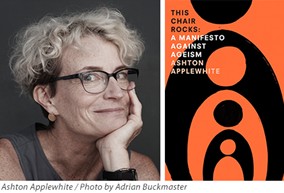
about what older people can and should be doing. In her mid seventies, she stepped onto the TEDx stage and delivered a talk that stopped people in their tracks. In her late seventies, she co-authored ReSet: Making the Most of the Rest of Your Life with Debra Yearwood — a book that is exactly what it sounds like: a blueprint for living boldly, later. Now Helen is sharing the "why" behind all of it, the back story, the conviction, the courage, and the moment she decided that the best chapters were still ahead. Her story is the Pass It On Network in action. ASHTON APPLEWHITE - WALKING THE WALKShe has spent years on the front lines of the battle against ageism — speaking, writing, organizing, refusing to let the world shrink older people into invisibility.
Then came a health challenge. And Ashton Applewhite did what Ashton Applewhite does — she turned it into a lesson. Known
internationally for This Chair Rocks: A Manifesto Against Ageism and co-founder of Old School Hub — the ultimate arsenal of arguments for standing up to ageism — Ashton recently picked up a cane. And rather than whisper about it, she published five reasons she's absolutely fine with that. - I can go places I otherwise wouldn't — like Christmas-tree hunting in a Colorado state park. That snow was slippery.
- People give me more space.
- I'm more likely to get a seat on the
subway.
- I'm walking the walk (pun intended) — setting a proactive example for non-disabled friends and followers of all ages.
- If and when I can no longer walk without a cane, the transition will be shame-free.
That last one. Read it again. That's what
liberation from ageism actually looks like. JACQUELINE STARK - HEALTHY AGEING: THE ROLE OF THE BRAINPIONeer Jacqueline Stark (Vienna) shared a newly published collection, Healthy Ageing: The Role of the Brain, featuring proceedings from the NGO Committee on Ageing’s conference held at the United Nations, Vienna, on 26 September 2025 in celebration
of the UN International Day of Older Persons. The publication brings together a range of expert perspectives on the brain’s role in healthy ageing and is a valuable resource to share with anyone interested in this topic. |
CHANGE, ONE CORNER AT A TIMEFrom Hamburg to Harare, from Paris to Portland — PIONeers are
watching and contributing to world change. Here's what caught our eye. Germany — Cash Is Not Obsolete Digital payments are leaving millions behind. A new German consumer survey shows that declining cash acceptance is quietly locking out older people, privacy-conscious consumers, and anyone without digital
options. Consumer advocates are fighting back — demanding mandatory cash acceptance as a matter of inclusion, not just convenience. Germany — Culture Buddies Hamburg has found an elegant answer to loneliness — pair older people with younger culture lovers and send them to concerts, galleries and
theaters together. Music, art and theater as social glue. Simple. Beautiful. It works. France — Stop à l'Isolement Born out of COVID's brutal isolation, Stop à l’Isolement is a vibrant online meeting place sponsored by two of France's best-known TV personalities. From gardening clubs to sing-alongs to practical social information — new reasons to connect, every
single week. Zimbabwe — High Tea, High Dignity Once a month, older women in Zimbabwe who belong to the Power of Touch dress up, show up, and celebrate each other. Everyone brings what they can. No obligations. No competition. Just the radical, simple joy of being seen and valued. Never underestimate the power of a good cup of
tea. International — SDG Progress Watch 36 countries are stepping up for Voluntary National Reviews — a critical part of the UN's 2030 Agenda follow-up. Is your country on the list? Watch this space. USA — Never Again: The Essential Caregiver Bill COVID stole something unforgivable — people
died alone, with family locked out. A new bipartisan, bicameral bill aims to make sure that never happens again, requiring skilled nursing facilities nationwide to guarantee in-person access for essential caregivers whenever regular visitation is restricted. This one matters. New Zealand — Never Too Late to
Start Starting a business in later life is a growing global trend — and New Zealand is taking it seriously. The government's Better Later Life 2019–2034 strategy includes a pilot program helping older entrepreneurs build sustainable businesses from the ground up. The evaluation report is comprehensive and well worth your
time. Central America — One Stove at a Time Over 2.1 billion people worldwide still cook over open fires — with devastating consequences for health and the environment. Twenty years ago, Nancy Hughes, a stay-at-home mom with a Rotary Club and a mission, decided to do something about it. Today, Stove Team has delivered more
than 3,000 Justa Cookstoves across Central America — and counting. Proof that one person really can change the world. Every snippet above is someone, somewhere, refusing to accept that this is just how things are. Sound familiar, PIONeers? |
6 May 2026 Launch video for Helen Hirsh Spencer’s book co-authored with Debra Yearwood. Sign up at Eventbrite now and choose from two FREE sessions: 1:00-2:00 pm EDT, or 9:00-10:00 pm EDT 5-8 July 2026 23rd IAGG world congress of gerontology and geriatrics, in Amsterdam, The Netherlands. Theme: Ageing well in a globalised world. 13-17 July 2026 IGWA Drafting a convention on Rights in Geneva
Register for the 1st
session of the Intergovernmental Working Group on Older Persons (IGWA). 14-15 September 2026 Cannes - The 2026 edition of the SilverEco & Ageing Well International Festival highlights on Everyday Care, Lasting Dignity, The Role of
Hygiene in Ageing Well, Silver Economy market report: a growing opportunity in the face of an ageing population SilverEco & Ageing Well International Awards – applications are open. |
25-28 October 2026 Leading Age Annual Meeting,
Philadelphia PIONeer Verna Covey is among the presenters on Leading Age’s National Day on 25 October. Her subject: "Innovating Together: Partnerships Between Senior Living and Academic Health." It is a partnership between her community, Clermont Park, and the Multidisciplinary Center on Aging at the University of Colorado. 9-12 November 2026 UN World Data Forum – Riyadh, Saudi Arabia The UN World Data Forum (UNWDF) aims to spur
data innovation, nurture partnerships, mobilize high-level political and financial support for data, and build a pathway to better data for sustainable development. Since the first Forum in January 2017, the audience for the Forum has grown from 2,000 people to active stakeholder group of over 20,000. The call for program proposals is open - [email protected]. Advocating for the Rights of Older People
|
Thank you for reading! We encourage you to "pass
on" our newsletters to your colleagues and friends and ask them tosubscribe here. |
If you wish to unsubscribe at any time, please click here and youwill be immediately removed from this Newsletter. Thank you. |
|
|
|